A personal habit of tracking my own health data turned into a Harvard research finding, a story in The Verge, and the moment I realized what kind of career I actually wanted.
I've been exporting and analyzing my own health data for years, long before it had anything to do with my job. I started collecting HRV data from my Apple Watch in December 2018, using an app called Health Auto Export to pull the raw HealthKit numbers into a CSV, no processing, no filtering, just the same data Apple itself gives you access to. I exported it once in September 2020 and again in April 2021, mostly out of habit. Both exports covered the same historical stretch, December 2018 through September 2020, so out of curiosity one day I lined the two files up next to each other.
They didn't match.
A Habit, Not a Study
This wasn't a research project. At the time I was a research fellow in the Department of Neurosurgery at Brigham and Women's Hospital, working on formal outcomes research with published, peer-reviewed methods behind it. This was something else entirely, the same personal habit that's shown up in nearly everything I've built since: if I have data on myself, I want to actually look at it. Wearables, sleep, glucose, my own communication patterns, if the data exists, I want to understand it. Re-exporting old HRV data and comparing it against itself wasn't research. It was just what I do.
Two Exports, Two Different Answers
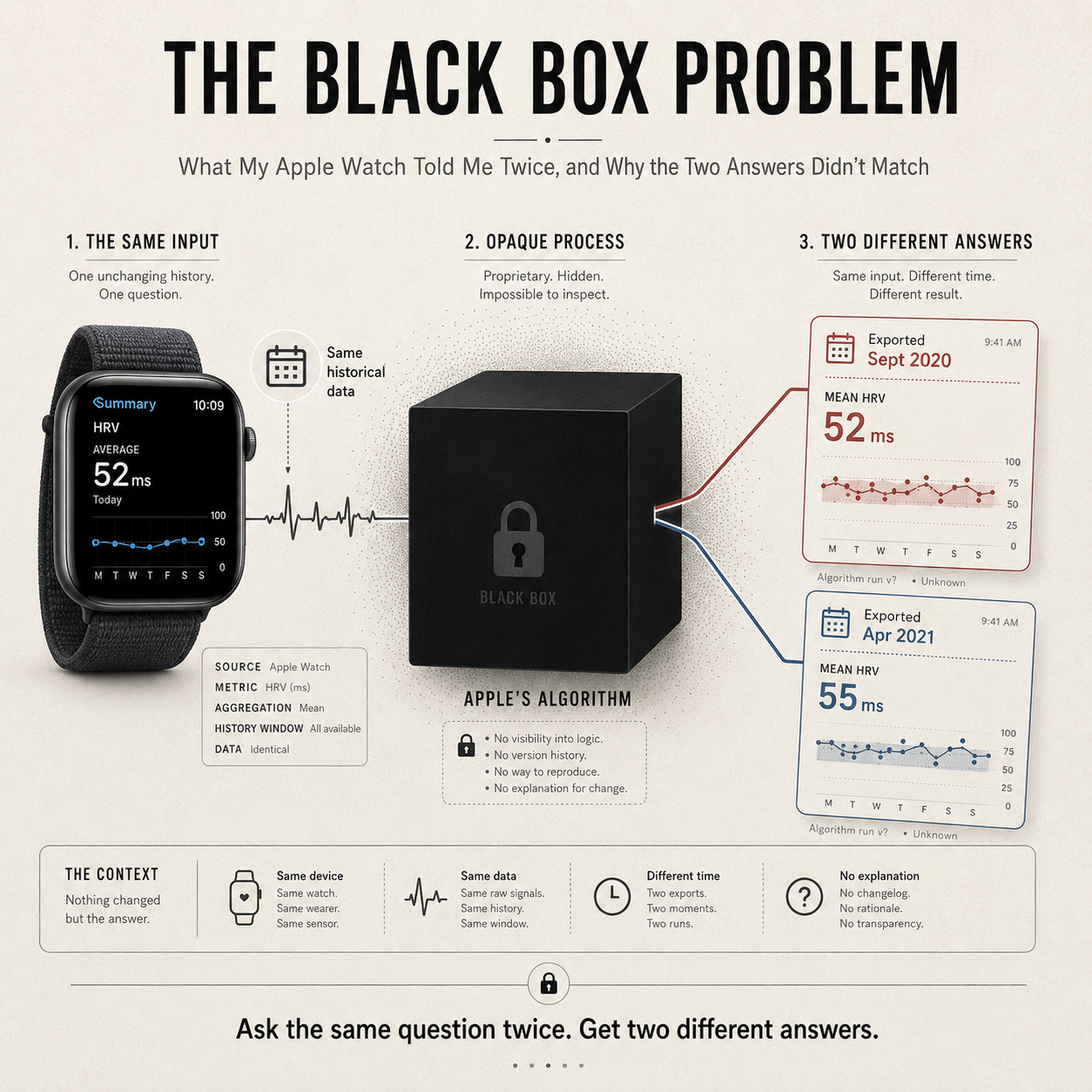
The two exports covered 640 overlapping days, with data missing for only 18 of them, so the comparison was about 97 percent complete. If nothing had changed on Apple's end, the two files should have been identical. Nothing about my actual heart rate data from 2019 had changed. It already happened.
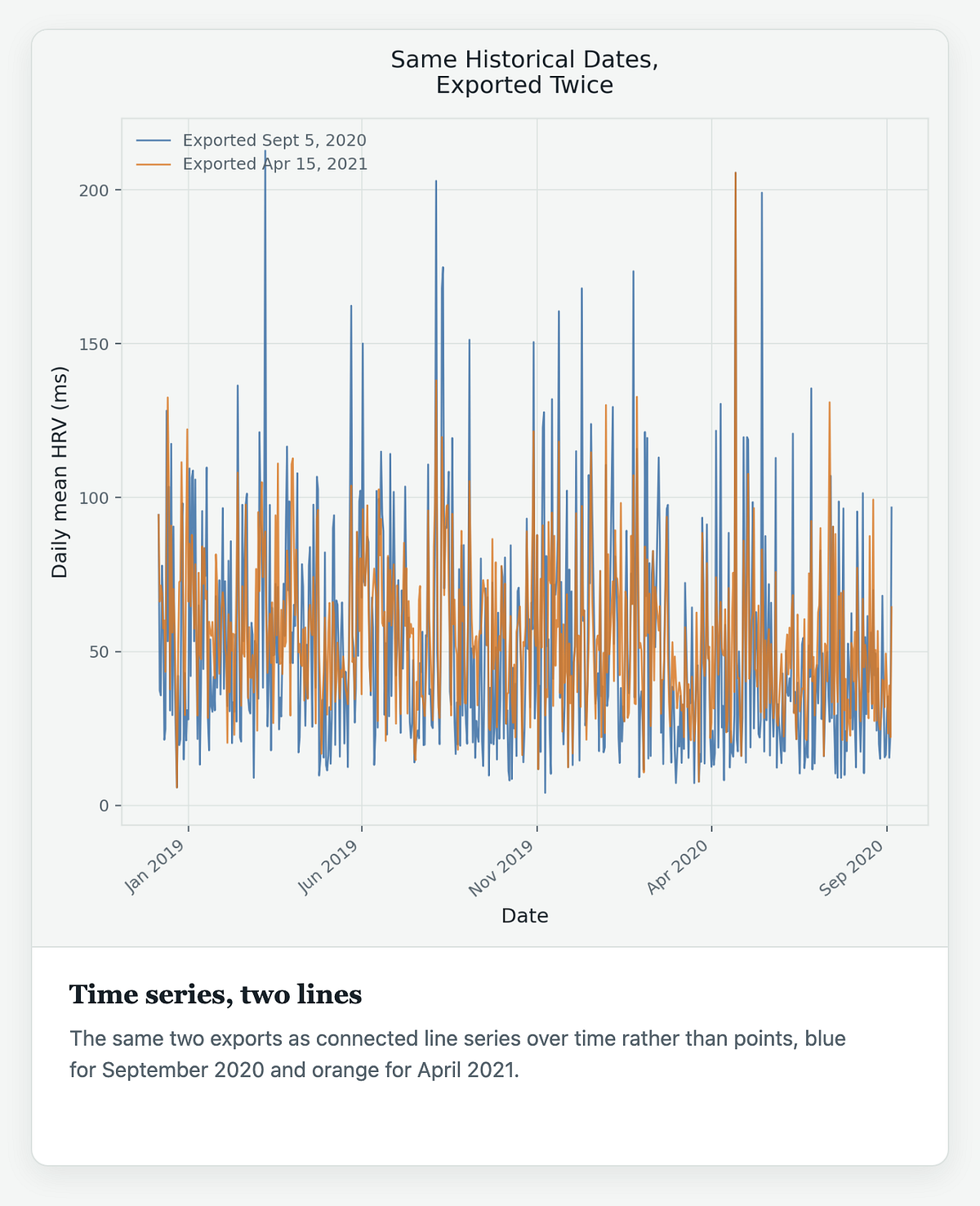
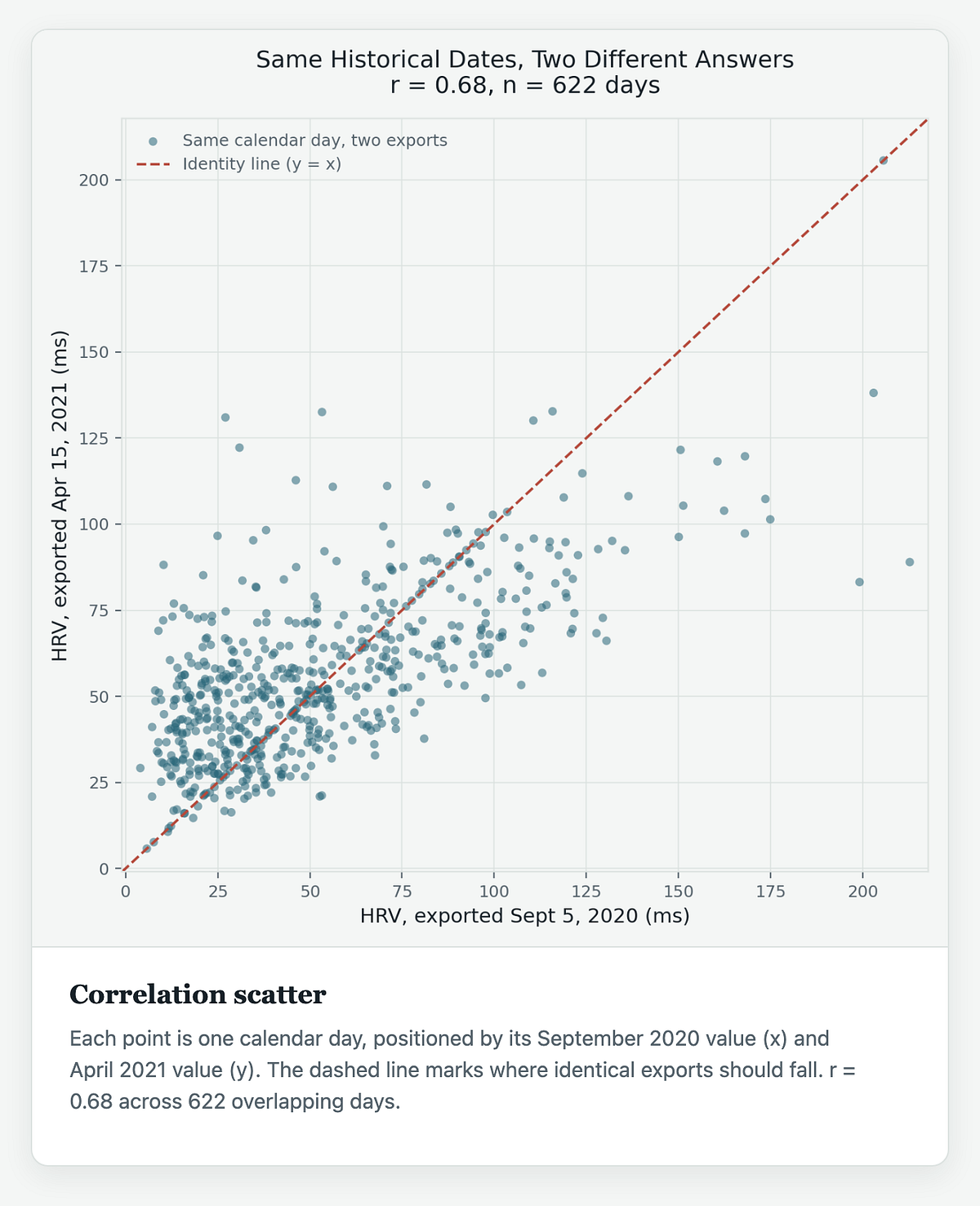
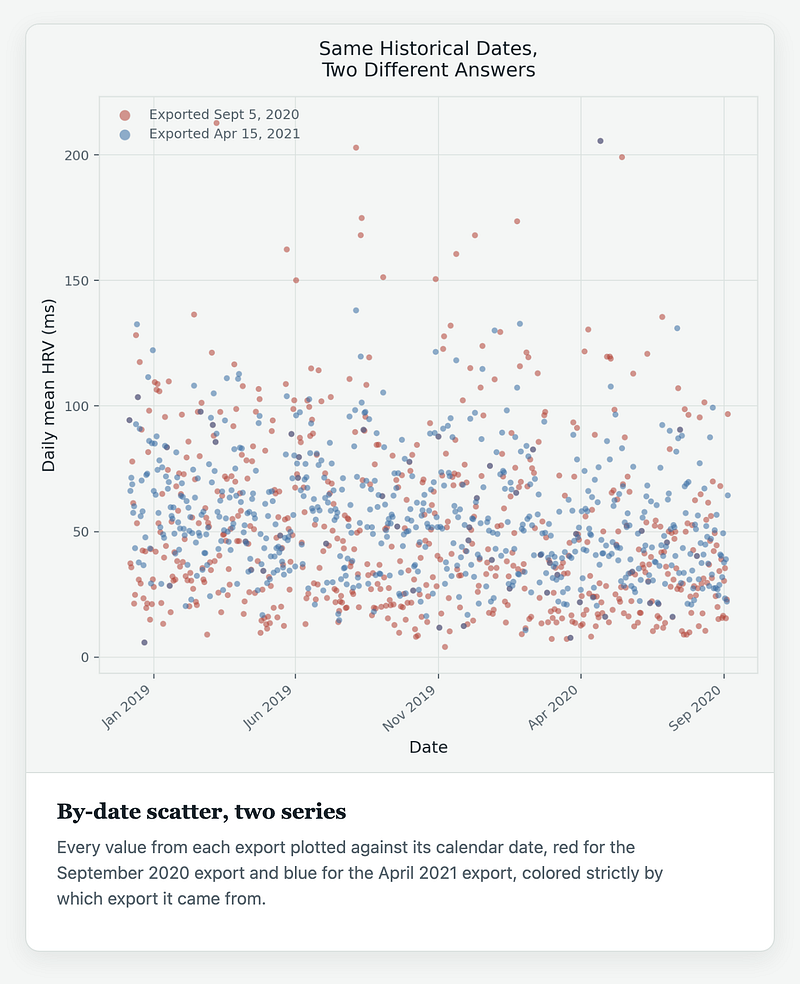
But it wasn't identical. The daily mean HRV was close between the two exports, 52 milliseconds versus 55, but the variance was wildly different, 1240 versus 572, and when I plotted one export against the other, the points scattered instead of falling on a clean diagonal line. The correlation between the two supposedly identical datasets was just 0.67.
Something had reprocessed my historical data between the two export dates, silently, with no notice and no way for me to know what had changed or why.
Sharing It With JP Onnela
I shared what I'd found with JP Onnela, PhD, a biostatistician at the Harvard T.H. Chan School of Public Health and the developer of Beiwe, the open-source digital phenotyping research platform. JP had long argued that researchers should work with raw sensor data instead of the pre-packaged summaries wearable companies provide, precisely because those proprietary algorithms can change without warning and quietly undermine reproducibility. What I'd stumbled into from pure personal curiosity turned out to be about the cleanest real-world example of that exact problem he'd ever seen.
Here are the actual plots he and I put together from that comparison:
It Made The Verge
JP's blog post was picked up by The Verge a few weeks later, in a piece titled "Apple Watch's data 'black box' poses research problems" by Nicole Wetsman, published July 27, 2021. JP told the Verge, "These algorithms are what we would call black boxes — they're not transparent. So it's impossible to know what's in them."
Olivia Walch, a sleep researcher at the University of Michigan who works closely with wearable and app data, had been pushing for years for researchers to pull straight from a device's raw sensors instead of trusting whatever number its software hands back. Our mismatched exports gave her something she'd wanted for a while: an actual case to point to.
It's validating, because I get on my little soapbox about the raw data, and it's nice to have a concrete example where it would really matter
- Olivia Walch, University of Michigan
Apple itself said any algorithm changes only apply going forward and that the watch doesn't recalculate past data, though it had no explanation for what actually happened in this case.
Becker's Hospital Review, 9to5Mac, MacDailyNews, and iDropNews all ran their own versions of the story.
What This Actually Changed for Me
None of this happened because someone asked me to look into it. It happened because I already had the habit of treating my own body as a dataset worth taking seriously, and because years of formal research training had taught me not to trust a number just because a polished consumer app handed it to me. Those two things don't usually sit in the same person. Most people with the personal habit of tracking their own health data aren't thinking about algorithmic reproducibility. Most people trained to be skeptical of black-box research data aren't the type to re-export their own Apple Watch history for fun. I happened to have both, and that combination is the actual reason I was the one who noticed.
It also clarified something I hadn't fully admitted to myself yet. Up to that point my research work was mostly downstream of data collection, analyzing outcomes other people or systems had already gathered. This was different. This was hands-on, close to the actual sensors and pipelines and export formats, and it was the most engaged I'd felt in any project in years, despite doing it for free, on my own time, with no one asking me to. That was the moment I realized what I actually wanted to do next: build the tools and systems that collect health data properly in the first place, for researchers and for regular people trying to understand themselves.
A little less than a year later, I joined Harvard T.H. Chan School of Public Health as Head of Platform for Beiwe, the same digital phenotyping research platform JP developed.