A personal case study in treating a job search like a product problem.
Job searches are overwhelming. Juggling resumes, tailoring applications, and figuring out which roles actually align with your long-term goals is a lot to hold in your head at once. I wanted a tool that could keep me organized, give me strategic feedback, and actually support me through the whole process, not just one application at a time. So I built one.
This became a side project for putting my product management background to use on my own problem. I treated it like launching a real product: building, testing, refining, and iterating based on user feedback. I went through multiple rounds of trial and error, rewrote prompts to fix hallucinations, and shaped the design with real-time feedback from my sister, who was on the job hunt herself at the time. Her feedback told me which features actually mattered in a real search, not just which ones sounded good on paper. It also became one of the first projects where I took prompt engineering seriously as its own discipline, not just getting a GPT to respond well once, but learning how to make it hold up reliably, the same way you'd iterate on real software.
My own background spans clinical research, operations, data analytics, product management, and two startup stints. That mix meant one of my biggest challenges wasn't finding a job, it was figuring out which job actually fit both my skills and my interests. I needed something that could see the pattern across very different kinds of opportunities and gradually build a picture of what an ideal role looks like, not just score one job description at a time, but accumulate a living, evolving profile of what I was actually looking for.
That's JARVIS: Job Analysis & Role Vetting Intel System.
Why I Built a Custom GPT
Most job seekers are juggling the same handful of problems at once: how well they actually match a given role, how to tailor a resume and cover letter for it, what career trajectory makes sense long-term, and how to keep track of it all without losing the thread. I needed something that could do all four: evaluate fit, tailor materials, suggest paths, and remember what it had already learned about me as I went.
The result is a GPT trained specifically to support every stage of a job search, from strategy down to execution.
How JARVIS Works
I trained JARVIS with a detailed prompt that sets explicit rules and a fixed four-step workflow, rather than leaving it as a general-purpose chatbot.
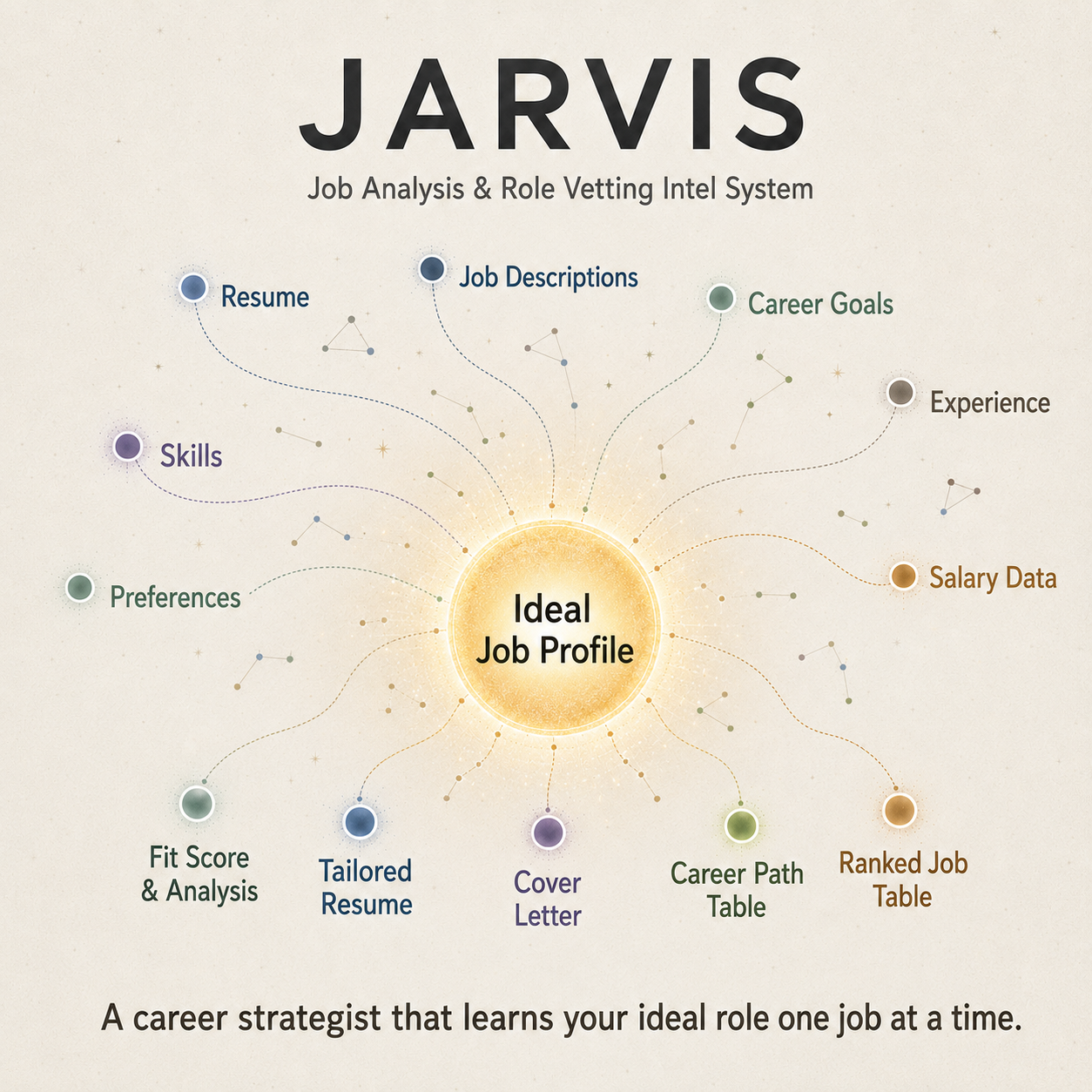
Resume upload. JARVIS starts by asking for a resume. That resume becomes the foundation for every evaluation and tailoring pass that follows. Nothing gets invented that isn't already there.
Career path mapping. From that resume, JARVIS generates three distinct career paths, each as a table: three steps per path, timelines, key responsibilities, the types of companies to target, and salary ranges. It offers to save any path for later reference, so the paths persist across the conversation instead of evaporating the moment I move on to evaluating a specific job.
Job description evaluation. Every job I share gets scored and logged: a fit score out of 100; a table of strengths with explanations; a table of weaknesses paired with specific resources or courses to close the gap; a target salary range; a summary of how the role fits into the long-term picture; and a running, ranked table of every job I've evaluated so far, complete with notes carried over from earlier in the search. Underneath all of it, JARVIS is continuously updating a real-time "ideal job profile" based on everything I've fed it. Job ten benefits from what job one taught it about me, and every new evaluation refines the picture instead of starting cold.
At any point, I've been able to ask JARVIS to show me an updated job ranking table and it's good about giving you a full list of all the jobs you've fed it, sorted by fit score and the details about those jobs.
- JARVIS user
Resume and cover letter tailoring. After the evaluation, JARVIS offers to tailor the resume or draft a customized cover letter for that specific role.
Importantly, it never adds new content, changes job titles, or invents experience. It only rewords what's already in the source resume, for clarity and ATS keyword optimization, never for embellishment.
What's Under the Hood: Prompt Engineering as a Discipline
JARVIS runs on GPT-4, customized with a system prompt that encodes five specific domains rather than leaving them to general-purpose reasoning: career analysis, resume vetting, role and career-trajectory comparison, salary benchmarking, and professional writing for job materials. It's also grounded to pull real-time information from the web, so a fit score or a salary range reflects the current market instead of whatever the model happened to learn during training.
I later rebuilt the same prompt and structure as a Gemini Gem, running side by side with the GPT version. That was as much a test of the design as a convenience feature. If the workflow held up moving to a different underlying model, it confirmed the actual product was the prompt and the process, not the platform it happened to run on.
The tech stack behind all of this is close to nothing: one model, no external APIs, no database, no code. The real work was prompt engineering itself: designing a prompt, testing it against real inputs, and revising it through repeated iteration, the way you'd build and test any other piece of software.
That iteration wasn't solo guesswork. I ran informal interviews with my sister and a handful of friends who were also job hunting at the time, walked them through what I was building, and had them test new versions of JARVIS against their own real resumes and real job searches as I shipped new features. Their feedback is what told me which features actually mattered versus which ones just sounded good on paper, and it shaped several of the guardrails directly.
Getting rid of hallucinations wasn't a single fix. It took multiple rounds of A/B testing specific phrasing against real resumes until the outputs stopped drifting. The guardrails around resume tailoring, never inventing content, never changing a job title, never fabricating experience, are written directly into the prompt as explicit rules, then tested against edge cases where a model might otherwise be tempted to help by embellishing. A custom GPT has no database, so the running ranked table of every job evaluated and the continuously evolving ideal job profile don't exist anywhere outside the conversation itself. They persist only because the prompt tells the model to reference and restate that state on every turn. That's harder to pull off than it sounds. Instructions that held up cleanly for the third job evaluated would quietly degrade by the fifteenth, so testing had to happen deep into realistic, long sessions, not just the first exchange.
None of that shows up in a tech stack line, but it's the actual skill I walked away with: treating a prompt like a spec, writing it, running it against real inputs, finding where it breaks, and rewriting it. That discipline carried straight through from JARVIS into nearly everything I've built with AI since.
Why It Changed My Job Search
With JARVIS in the loop, I've been able to make sharper career decisions through structured path planning, apply faster with resume and cover letter automation already tailored to the role, and know precisely how I stack up against a given job before I spend hours on an application. More than any single feature, it's kept me anchored to roles that actually align with a long-term direction, instead of sliding into the desperate, apply-to-everything mode that job searches tend to produce once the rejections start piling up.
One of the best things about the tool is that it keeps me focused on looking for jobs that align with the long-term plan JARVIS suggested. This has helped me keep my search targeted toward my own growth goals, rather than falling into that desperate mode where we apply to everything.
- JARVIS tester
It works like a career strategist I can check in with any time, backed by AI but working entirely from my own content and direction.
As with any AI-generated output, review everything before you use it, especially resume tailoring and cover letters, and make sure the final version still sounds like you.
What's Next
The current version has already reshaped how I run a job search, but there's a clear roadmap of where this goes next: live job feed integration so JARVIS can proactively surface roles instead of waiting for me to paste one in; ongoing skill-gap analysis that updates as the ideal job profile evolves; a built-in application tracker with interview prep and follow-up email generation; real-time ATS scoring and LinkedIn alignment suggestions; and eventually, shared access so a mentor or peer could weigh in on the same evolving profile.
Try It Yourself
JARVIS is live, and I've made it available for anyone to use: Try JARVIS → https://chatgpt.com/g/g-67df30b40e948191b6d71464ff859a21-jarvis-job-analysis-role-vetting-intel-system
Whether you're pivoting careers, climbing the ladder, or exploring a new industry entirely, a custom GPT like this doesn't take much to build. A clear prompt and real clarity about what you want it to do gets you most of the way there. Happy to share more on how I approached the design if you're building your own.
More than the tool itself, this project is where prompt engineering, guardrail design, and structured user research actually became real skills for me, ones I still lean on for nearly everything I ship with AI now.
I still use JARVIS every time a new role catches my eye, and the ideal job profile it's built up over time is honestly a more accurate read on what I'm looking for than I could have written myself on day one.